
Black Forest timber for the Netherlands
The wooded slopes of the Black Forest have ensured that timber has been an important economic and trade good since the Middle Ages, all made possible by the woodcutters, raftsmen and timber merchants, who dubbed themselves ‘shippers’ due its waterborne transportation. Their endeavours achieved lasting fame in the 18th century, as these exports expanded to far-off cities like Mannheim, Mainz and Cologne. Further down the Rhine, the timber even reached the Netherlands, creating the ‘Hollander log trade’.
Dutch Michel
This unforgettable character features in the novella ‘The Cold Heart’ (1827) by Wilhelm Hauff. One of the ‘Black Forest Timber Barons’ is ‘Big Ezekiel’: “He travelled twice yearly to Amsterdam with building wood and had the good fortune to make a bigger profit every time.”
Dutch Michel conveys the traditional image of a raftsman – waders up to mid-thigh, strong as a giant and always ready to take a risk. He steers the raft of massive fir logs to Rotterdam, where the ‘Mynheers’ (lowland magnates) pay him dearly for them: when his comrades “saw these bags of guilders, they couldn’t believe their eyes. From then on, Holland was the raftsman’s paradise.”
Even today, the thickest and longest fir and spruce logs are dubbed ‘Hollanders’ in memory of that time when these titans of the forest were the gem in the Black Forest’s export crown. The biggest of all, the ‘prime-quality firs’ are 16 Baden inches (48 cm) thick at the thinner end (‘tapered top’), yielding lengths of 18 to 34 metres.
Pictures
Picture 1: The ‘Grandfather Fir’ in Freudenstadt and currently the Black Forest’s largest tree of its kind: height 46 m, girth 5.30 m, age 300 years (est.).
Picture 2: Winter work for woodcutters: stacking up the felled trunks for onward transport. Painting by Eduard Trautwein, 1859, Kurhaus Bad Rippoldsau
Picture 3: “Timber rafting near Wolfach”: Shipper with family, log rafts on the Kinzig, large stack of timber on shore, everyone in their Sunday best. Painting around 1820, in: Aloys Schreiber, Badisches Volksleben (1823).
Picture 4: Felling a Hollander fir by axe in Schiltach’s Stadtwald. (Andreas, Hartmut und Michael Brückner), 2015.
Black Forest timber for the Dutch merchant navy
With its enviable coastal position, the Netherlands became a noted trade and sea power during the 17th and 18th centuries, operating strategic footholds and colonies in the Americas (New Amsterdam), Africa, India and Indonesia (Java). These were maintained by sailing ships that transported trade goods of every kind – even slaves. By 1650, the country’s merchant fleet comprised 16,000 vessels, protected by the might of the Dutch navy. Shipyard output was now 2,000 merchant and naval vessels every year.
The timber required – hard-wearing oak for the ship’s hull, with sturdy fir and pine for the masts – was sourced by Dutch shipbuilders from the wooded uplands of the Mosel, Saar, Main, Neckar and Black Forest. The wood felled there was rafted down the mountain rivers to the Rhine and thence to Holland, with Dordrecht being the most important port.
The volumes of timber needed were monumental. A merchant ship could use as many as 1,000 oak trunks, while a large naval vessel took 4,000 – with coniferous timber on top. For ribs and other parts of the hull, oaks that showed curved growth were useful, but the trunks for the masts needed to be up to 30 m long. As preparation and transport involved a lot of money, time and risk, this Dutch business drove the creation of independent and well-financed timber companies. Most famous of all was the Holländer Holzhandelskompanie from Calw, which also operated in Kinzigtal.
Jakob Vollmar made the first trip, ‘shipping’ 500 Hollander logs in 1750. This earned him 14 guilders per log – as much as a raftsman earned in two weeks. These logs became more and more sought-after, with a 21-metre Hollander going for 32 guilders in 1785. Even so, large swathes of the northern Black Forest still remained untouched – over 100,000 Hollander firs along the Murg – turning the Black Forest into the ‘Hollander warehouse’.
Pictures
Picture 5: ‘Fleuten’, Dutch merchant vessels: three-masters with a capacity of up to 350 tonnes. Fairing work by Wenzel Hollar, 1647
Picture 6: Construction of a ship’s wooden hull, England 1942, Davies, F A (Lt), Royal Navy official photographer.
Picture 7: Dutch flagship with 96 cannons – the Dutch flag can be seen on the main mast. Coloured engraving by Gerard van Keulen, 1728.
Picture 8: Dutch windmills. An important source of energy, which therefore gave local shipyards a key advantage for shipbuilding.
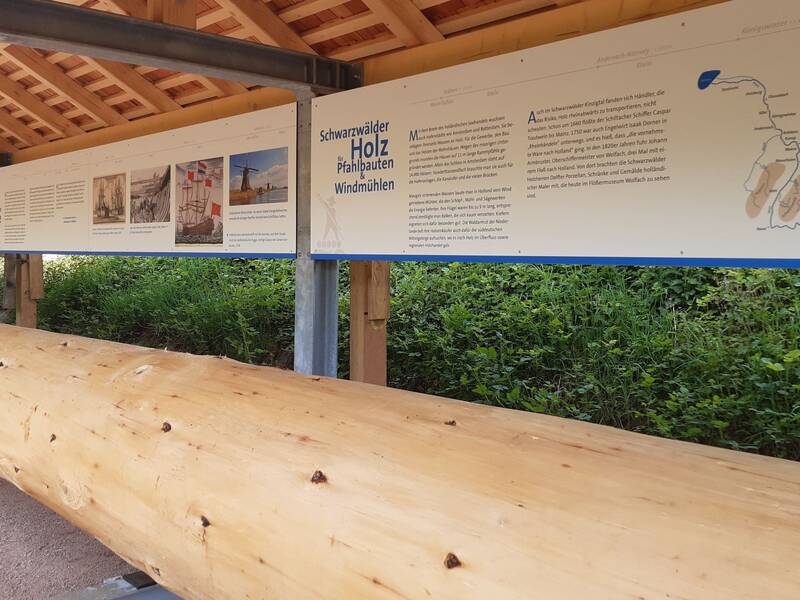
Black Forest timber for pile buildings and windmills
The boom in the Dutch seafaring trade also brought growth to ports like Amsterdam and Rotterdam. These cities also needed vast amounts of timber: for the skilled trades, for construction and for residential heating. Sited on marshy ground, their houses needed foundations made from rammed piles up to 11 m long. Amsterdam’s Royal Palace alone sits atop 14,000 such piles. Hundreds of thousands more were also needed for the port facilities, the canal banks and the city’s many bridges.
Faced with a lack of fast-flowing rivers, the Dutch built windmills to provide energy to their pumping stations, grinding mills and sawmills. With vanes up to 9 m long, timber beams were needed that would resist deformation under load. Pine was especially suited to the task. Rich in coastline but poor in forests, the Dutch sent their buyers to southern Germany’s Mittelgebirge, where there was wood in abundance plus a regional timber trade.
Kinzigtal in the Black Forest was one such place, where merchants were happy to take the risk of sending wood down the Rhine. As early as 1660, Schiltach’s shipper Caspar Trautwein was already rafting timber to Mainz. By 1750, innkeeper Isaak Dorner was also busy in the Rhine trade, with “the best logs of all destined for Holland.” During the 1820s, Johann Armbruster, Master Shipper of Wolfach, steered a log raft to Holland on no less than three occasions. The Black Forest timber barons took back porcelain from Delft, with cabinets and paintings from Dutch masters, which are now on display in the Wolfach Rafting Museum.
Map: Timber trade and rafting locations on the Rhine
Pictures
Picture 9 & 10: Oil painting, Dutch artist, brought to the Black Forest by shippers from Wolfach, 18th century, private collection Wolfach.
Picture 11: Timber for Holland: Rhine raft near Lorelei, etching by H. Emden, around 1840, Rhenish Picture Archive Cologne.
Picture 12: Amsterdam: Houses showing a slight lean due to pile cap mat settling.
Rhine rafts and capital rafts - How the timber came to Holland
The Black Forest was only able to supply Holland with timber thanks to the rafting operations that managed to move this heavy cargo along more than 770 km of waterways. The logs were also restacked several times along the way:
bundle rafts, Rhine rafts and capital rafts
On the Kinzig, ‘bundle’ rafts of up to 350–450 m were used and brought down to Kehl on the Rhine. Here, the timbers were rearranged into ‘Rhine’ rafts, which were three-layer stacks of timber (90 x 12 m), steered by about 40 raftsmen to Mannheim or Mainz. Enlarged here yet again, new teams then moved the rafts on to the Middle Rhine, which was especially challenging due to wind, rocky reefs and choke points (Lorelei).
At Koblenz, the rafts were assembled into ‘capital’ or ‘Hollander’ rafts, whose dimensions – 350 m long, 45 m wide, draught of 2.5–3 m – were truly astonishing. Steered front and aft with heavy rudders, these monsters needed a crew of 350. Huts and supplies were provided aplenty for the raftsmen and passengers, some 500-600 persons all told. After a three-week voyage – through murky depths, treacherous sand banks and bad weather – they finally reached Dordrecht. Here the trunks were laboriously ‘rafted out’ and auctioned off in the presence of their owners. Johann Armbruster of Wolfach made the trip three times, returning home each time by stagecoach with his money pouch bursting at the seams.
Schiltach also saw “a significant influx of wealth due to the river-rafting of Hollander timber.” This meant work, bread and profit – as shown by its large post-and-beam houses. While the Hollander timber trade brought prosperity, it had a dark underbelly: widespread deforestation. Aggressive clear-cutting destroyed ancient woodlands and virtually wiped out the native oak.
‘Predatory logging’ and an ‘ecological disaster’
Reforestation efforts in the 19th century relied on the fast-growing spruce, permanently changing the earlier deciduous and mixed forests into evergreen monocultures. Only in recent times have these now been mitigated by foresters planting a wide range of tree species.
Pictures
Picture 13: Ceramic piece from Delft (‘Delft Blue’), brought back from Holland, early 19th century. Private collection Wolfach
Picture 14: ‘Capital raft’ on the Rhine near Bonn. Coloured copperplate by J. E. Grave from a sketch by J Bulthuis, 1796, Siebengebirgsmuseum Königswinter.
Picture 15: Rafting out (‘sluiten’) a raft in Dordrecht, copperplate by C. F. Bendorp, 1785. – Studiezaal Stadsarchief Dordrecht.
Picture 16: By the 20th century, ‘Hollander’ trunks were already a rarity. Cumbersome rappelling and loading of a ‘Hollander’ in Lehengericht, about 1930
Silver fir from Tiefenbach (Schiltach, Black Forest)
Tree: ‘What I was’
Species: Silver fir
Height in forest: 42 metres
Volume in situ: approx. 12.5 solid cubic metres
Felled by axe 21 April 2024
Trunk: ‘What I am’
Length in storage: approx. 19 metres
Diameter at basal stump: 1.0 metre
Diameter at tapered top: 0.6 metres
Volume: approx. 8 solid cubic metres
Dry weight: approx. 5 tonnes
Trunks of this size are also termed ‘Hollander trunks’.