
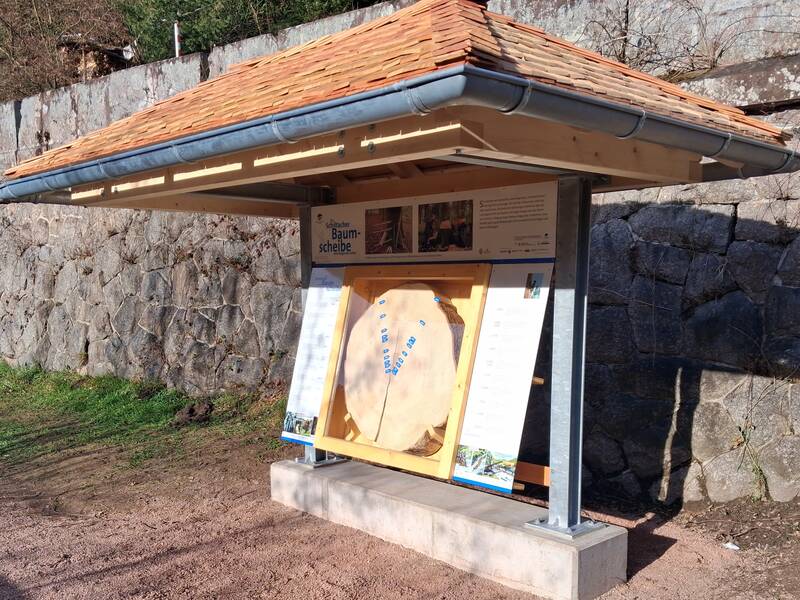
The Schiltach tree disc – a witness to its times
The disc is taken from the stump of the nearby ‘Hollander fir’ and shows its growth rings. The number of annual rings tells us the tree’s age. The width of the annual rings also tells us a lot about the life of the tree. Closely-spaced rings indicate slow growth, due to periods of low rainfall or drought. Rings spaced wide apart mean that conditions were good, with plenty of light, rain and few pests.
Pictures: The pictures illustrate the tools and the felling of our Hollander fir by the Schiltach raftsmen.
The life story of our tree disc
1842 A ‘Hollander fir’ sapling: it takes root at a time plagued by failed harvests, inflation and a crisis in the timber trade. Many people decide to emigrate to America.
1843 Dedication of the town’s Evangelical church as a spacious, round-arched building. With space for 1,400 people, the building is one of the largest Protestant churches in Baden.
1848/49 German Revolution: uprising against the monarchies, calling for popular participation in governance and a unified nation state. Schiltach’s citizens also take up arms as ‘irregulars’.
1862 Some 79 rafts are steered downriver on the Kinzig by Schiltach raftsmen. One part of this wood goes from Kehl to Strasbourg, the other travels on the Rhine to Mannheim and Mainz.
1870 Migration of Kinzigtal raftsmen to Transylvania (Romania). On rivers in the Carpathian Mountains, they steer timber shipments as massive ‘bundle rafts’ built in the Black Forest style.
1871 Founding of the German Empire, ruled by Kaiser Wilhelm I. An industrialised nation takes shape, with a growing working class. Textile factories and metalworks open in Schiltach.
1886 The railway comes to Schiltach, as part of the Kinzigtal line from Offenburg to Freudenstadt. It marks the end of river-rafting and still runs today. Schiltach has two stations.
1894 End of commercial rafting on the Kinzig. Railways and pole trailers now handle timber freight. The last Schiltach raft was 600 m long.
1914/18 First World War, whose effects are also felt in Schiltach: 111 fallen, many war-wounded, war widows and orphans, hyperinflation, financial ruin and widespread hardship.
1919 Weimar Republic: a parliamentary democracy with elected President. Forced to accept the Treaty of Versailles. Schiltach experiences a ‘once-a-century’ flood.
1933 National Socialism in Germany: the authoritarian government demands approval and obedience, opposition is outlawed, persecution of political and racial ‘undesirables’.
1939/45 Second World War: for Schiltach, Hitler’s war means 159 fallen soldiers and many men with permanent frontline injuries. The little town itself suffers no damage, however.
1945 Schiltach is occupied by French troops – without a shot fired. Denazification but schools reopen quickly, formation of political parties and prohibition on assembly abolished
1949 Germany is split into two countries: the Western Occupation Zones become the Federal Republic of Germany, while the Soviet Zone becomes the German Democratic Republic.
1952 State of Baden-Württemberg: in Schiltach, 85% of the electorate agree to the formation of this ‘South-Western State’.
1969 The USA launches Apollo 11 as a manned spacecraft with a mission to land on the moon. On 20 July, astronaut Neil Armstrong becomes the first person to set foot on the moon.
1990 Reunification of Germany. The groundwork was laid by the ‘Peaceful Revolution’ in the DDR and international negotiations (‘Two Plus Four Treaty’).
1998 The ‘Schiltacher Flößer’ association is formed, with the aim of practising and preserving the centuries-old rafter’s trade as living history for the town of Schiltach.
2002 The nearby ‘Hollander fir’ is felled with the axe, in the traditional woodcutter style. Artificial Intelligence becomes commonplace in business, trade, education and the media.
2024 Introduction of the euro, which seeks to give Europe greater economic stability, political unity and international influence. The euro is a tangible symbol of European identity.
Cartoon
From the woods to the waves, from tree to raft... rafting in cartoons, by Jonatan Alcina Segura (Cádiz/Freiburg, © 2025)
The timber is felled and carted from the forest to the river, where a long journey is about to begin.
At the water’s edge, the collected tree trunks are prepared and bound together.
This assembly process turns the timber into a kind of boat: the raft.
The voyage covered 70 km, up to Willstätter Weiher.
Water needed to be dammed up before the raft could be moved. When the weir was opened – ‘Flash the gates!’ – the journey finally began.